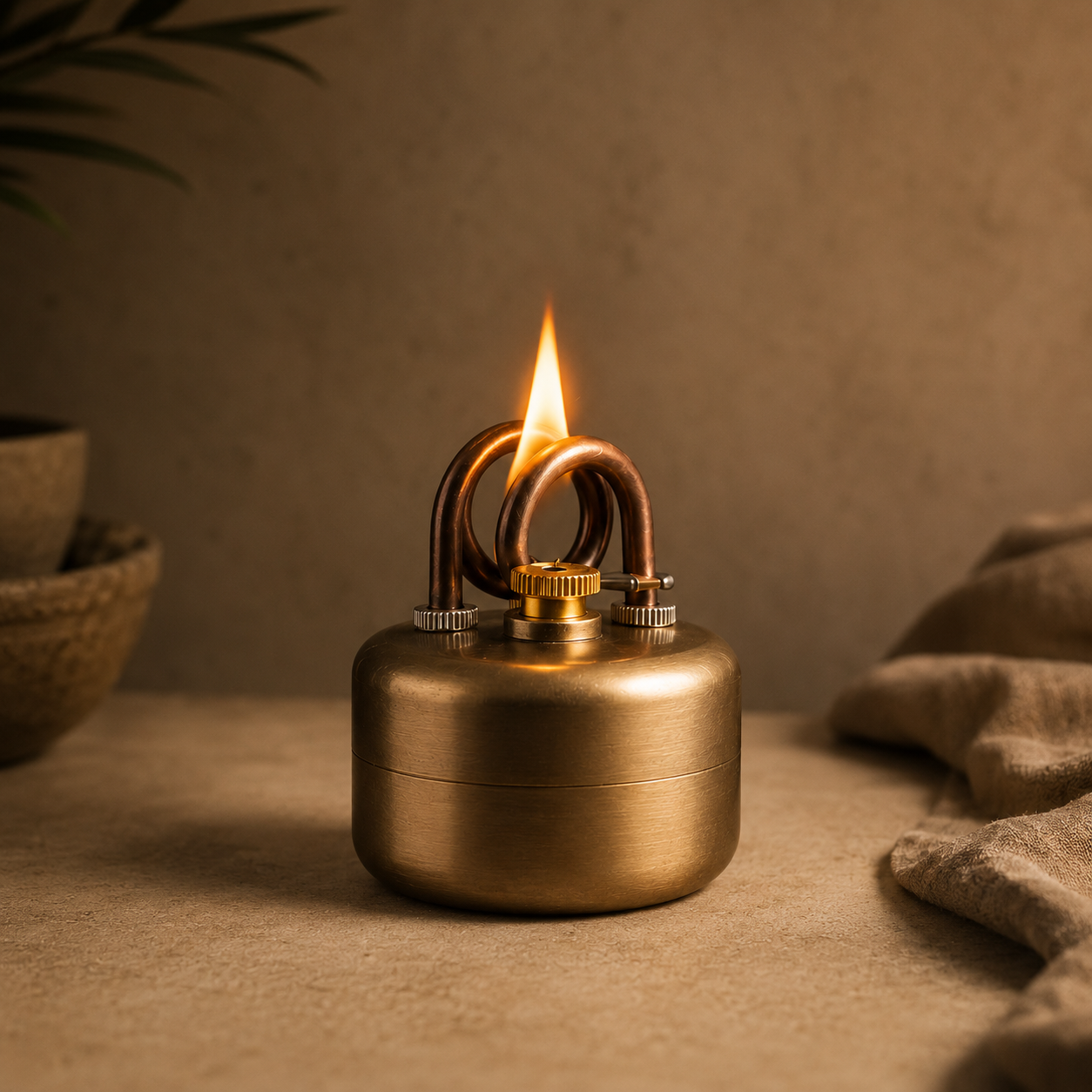
I started pulling threads.
Why was there no option built for inside?
Why had every emergency product I was sold been designed to live outside the house?
The deeper I went, the uglier the answer got.
In 1930 almost every American kitchen had a backup flame already built in.
If the stove was electric, the oven was gas.
Or there was a woodburner in the kitchen.
Or a small spirit lamp on the counter for coffee when the lights went down.
A hundred years ago nobody even thought of this as prep.
It was just how a kitchen was built.
Then came the mid century push to electrify everything.
Utilities wanted the house on one meter.
Builders wanted it cheap.
The all electric kitchen was sold to our parents as modern, clean, the future.
And the backup flame got erased from the floor plan.
Nobody told my parents.
Nobody told me.
One by one every house I ever lived in traded away the one thing that lets a kitchen work when the lines go down, and the whole country was told it was an upgrade.
So the Cooking Gap is not a thing I failed to prepare for.
It is a thing that was engineered into the way my house was built.
The moment I understood that, I started looking at a very different question.
Not what is new that I can buy.
What did people use before we lost this?
A hundred and fifty years of surgeons, soldiers, sailors, climbers, and European grandmothers all pointing at the same little piece of brass.
The trail got interesting fast.
Because the flame I ended up at has been inside human kitchens, hospitals, ships, and tents for longer than the power grid has existed.
Europeans never let it go.
Walk into any proper dinner service in France or Switzerland and you will see a little blue flame burning three inches from the food, under a fondue pot, warming a dish of butter.
The French call it a rechaud. The Germans a spiritbrenner.
It sits on linen tablecloths next to crystal and nobody flinches.
It has been there a hundred years.
Field hospitals in both world wars boiled instruments and brewed tea on exactly this flame.
A nurse working out of a canvas tent in freezing mud could not have a propane canister next to a wounded soldier.
She needed a flame that was small, that was clean, that would not blow up if a shell landed too close.
This is the one she used.
Submariners used it. In a sealed metal tube under the ocean you cannot vent exhaust and you cannot risk a canister.
The one hot drink the crew got on a long patrol came off an alcohol stove.
Mountaineers above fourteen thousand feet carry it because propane canisters freeze and quit when it gets really cold.
Alcohol does not.
The guys who summited Denali, the Everest base camps, polar expedition teams, this is what is in the pack.
Sailors on wooden boats use it because an open gas line on something that floats and leaks is a death sentence.
The classic marine stove, the one in every sailboat galley from 1870 to today, is an alcohol stove bolted to a gimbal.
Every single one of those people had the same problem I had.
They needed to cook a hot meal somewhere propane, gas, and electric would not work or were not safe.
And they all landed on the same answer.
A hundred and fifty years of surgeons, soldiers, sailors, climbers, and European grandmothers all agreeing on the same little piece of brass.
That is not survival gear.
That is just the tool that works when nothing else can.